

Whoever controls information controls power
From multinationals to remote work: how communication networks decide who rises — and who stays invisible
At least once in your working life you’ll have asked yourself: how on earth did So-and-so become head of that division? He can barely tie his own shoes, and yet there he is.
You keep your head down and work; he elbowed his way to the top, using everyone to look brilliant.
At first glance, this might sound like the usual rant of someone with an inferiority complex.
But stories like this come up all the time. I lived through them in consulting, friends tell me about them (in endless voice notes), and as a detached observer I actually find them interesting. Sometimes even funny.
How can this happen? In a meritocratic system, maybe it shouldn’t!
There’s one constant when certain people begin their climb: they put themselves at the centre of the communication flows. This isn’t necessarily something to be suspicious of, but it’s worth keeping one thing in mind: controlling information networks lays the groundwork for growing your own power.
In large multinationals it’s very hard to get noticed unless you’re also good at communicating. You can be the most skilled and diligent person in your division, but if your manager doesn’t acknowledge it publicly or sponsor you, you risk staying invisible. On the other hand, if you manage to win over the right person or become the keeper of vital information, you become irreplaceable.
Years ago I worked for a company whose way of doing things I didn’t much like — nothing illegal, just differences of opinion, I should add.
I took the job because some colleagues I’d worked with before were there, and I liked the idea of being on the same team again. Those colleagues had built the company’s entire web platform (which translates to: they held its institutional memory).
When I handed in my notice, alarm bells probably went off. Management knew how close I was to those key colleagues and called them in straight away to offer them a hefty raise: they were afraid of a domino effect.
They were irreplaceable, and the company knew it.
In his book Nexus, Harari describes information like this:
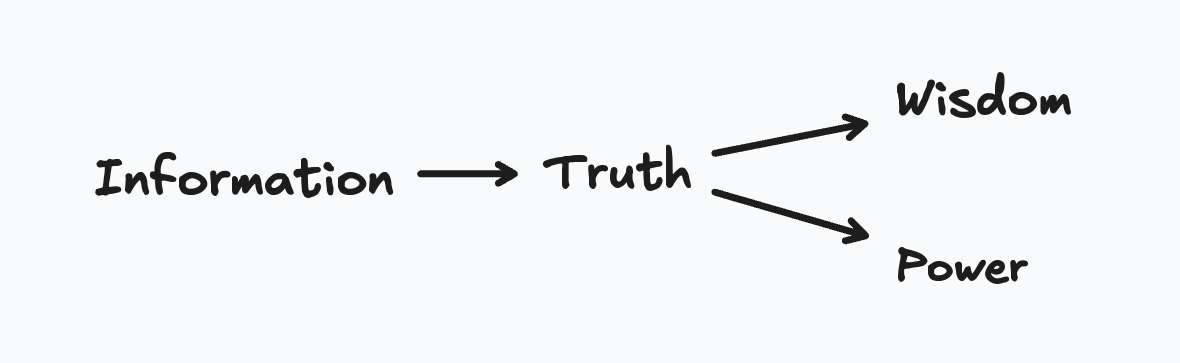
It’s commonly believed that being informed and well-read means discovering the truth, and that truth leads to wisdom and therefore to power. How many times have you heard “knowledge is power”? But this is what’s described as the “naive view” of information.
The naive view of information
If I’m a model employee, work hard, behave well and wisely manage the information that flows my way, I’ll get noticed and receive the recognition I deserve.
But that’s a naive view, especially in competitive environments where the game gets dirtier.
Just to draw a parallel: on social media and news sites we’re flooded with information from morning to night. The same piece of news can look extremely serious to some (of a certain leaning) and irrelevant to others (of the opposite leaning). To support their own thesis, people pick only the data that suits them (cherry-picking) and twist the context. In practice, everyone pulls the blanket to their own side.
The complex view of information
An envious colleague with access to plenty of information, and just as much freedom to spread it, can for example cast another colleague in a bad light. If there’s one thing history has taught us (fake news today, Nazi propaganda yesterday), it’s that a false story repeated often enough ends up being accepted as true.
If all this already happens in physical offices, imagine remote work, where empathy is reduced to a bare minimum and a quip or a word slipped in at the right moment is enough to damage someone’s reputation.
We can say that the view of information is more complex than the one shown before. In fact, we can picture it like this:
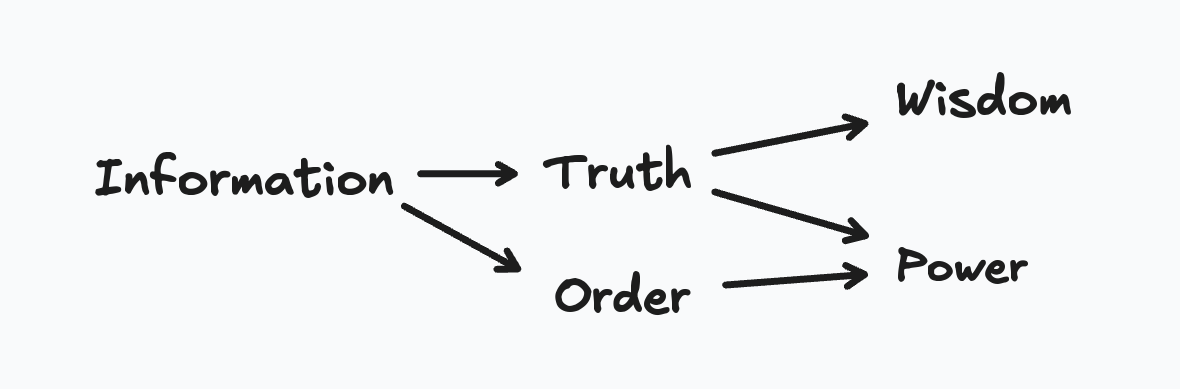
Information isn’t necessarily truth, and as I said before, a rumour can put a colleague who isn’t playing the same game in serious trouble.
How many times have you worked on a piece of software — or more generally on some area of a company — with no technical documentation at all, just one person who held the entire history of the project?
This is typically a concentration of power. And the more naive companies will do anything to hold on to that person — not for their technical merit, mind you, but for specific knowledge that was never passed on.
Given the status they’ve gained, these people will never willingly share their (exclusive) knowledge, because they become a hub (or bottleneck) for every kind of decision or change — all behaviours that hold back a team’s growth.
A piece of advice for companies: share the responsibility.
Distributed knowledge makes you strong. Centralisation, on the other hand, makes you fragile.
There are times when centralising all the information seems like a good idea: everything moves faster and ambiguity goes away. But at some point bottlenecks form: when that key person is missing, everything grinds to a halt.
Conclusion
In conclusion, when information always, constantly flows towards a single person, you can be sure that, for better or worse, that person will have power.
When someone holds exclusive information, they play it solely to their own advantage.
When all information passes through a single person, that person doesn’t just know, they decide what everyone else gets to know.
And at that point, it won’t be merit that sets everyone else apart, but the narrative that person chooses to push, about the project and about you.
At work, whoever controls information controls the narrative. And whoever controls the narrative controls power.